95 % of addresses at BKW, Groupe E and Romande Énergie are LEC-eligible.
WattMatch cross-referenced the public maps of the three distributors with the Federal Register of Buildings and Dwellings (RegBL) to compute, for every Swiss municipality, the share of its addresses that can join a viable Local Electricity Community. That is, whose installed photovoltaic capacity exceeds the legal 5 % threshold (Article 14 of the Energy Ordinance, EnV).
—
Addresses in a viable LEC
—
Viable LECs identified
—
Mobilisable solar surplus
—
Municipalities analysed
—
Updated
Overview · Switzerland
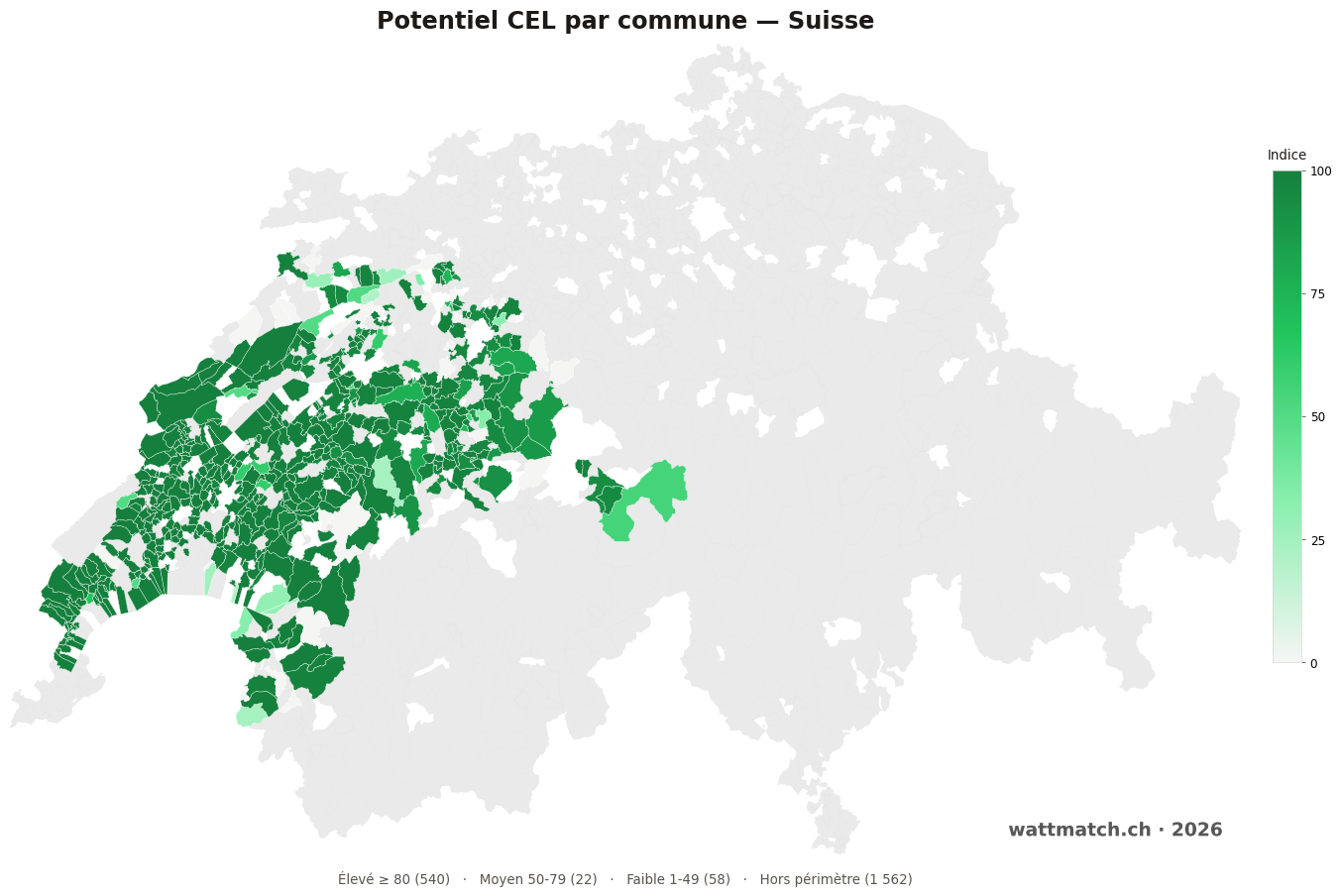
Index 0-100: share of addresses eligible to join a viable LEC
Outside the 3 analysed DSOs
The municipalities with the highest potential
Ranked by share of eligible addresses per municipality. All served by BKW, Groupe E or Romande Énergie.
All municipalities (2,182)
Sort by column, filter by text. Municipalities outside the three analysed DSOs are marked "Out of scope". We'll extend the analysis as the other DSOs publish their maps.
| Municipality | Canton | DSO | Eligible addresses | Viable LECs | Index | Tier |
|---|---|---|---|---|---|---|
| … | ||||||
How the index is calculated
The index is the share of addresses (connection points) in the municipality that belong to a viable LEC, a grouping of addresses whose photovoltaic capacity reaches at least 5 % of the subscribed power, as required by Article 14 EnV. LEC detection relies on cross-referencing the addresses from the public maps of BKW, Groupe E and Romande Énergie at two perimeters: transformer (≈ 500 m, network rebate up to 40 %) and substation (≈ 1.5 km, up to 20 %).
An index of 80 means that 80 % of the addresses in the municipality can already join a viable LEC today. An "address" here means a connection point to the grid, typically the main meter of a building. For multi-unit buildings, a single connection point serves several households: each one can sign up to the LEC individually if that point is eligible. Municipalities outside the three analysed DSOs (SIG in Geneva, ewb in Bern, ewz in Zurich, AET in Ticino, etc.) are listed with no index. Their LEC maps are not yet public; the analysis will expand as these operators release their perimeters.
Read the full analysis of the 3 DSOs →- BKW, Groupe E, Romande Énergie · public LEC maps
- SFOE · Sonnendach (photovoltaic potential)
- FSO · Federal Register of Buildings and Dwellings (RegBL)
- geo.admin.ch · municipal boundaries swisstopo · Art. 14 EnV (SR 730.01)
Disclaimer. Some of the values shown on this page are estimates derived from cross-referencing public sources (DSO maps, RegBL, Sonnendach). While WattMatch strives to ensure their accuracy, they are provided for information only and cannot give rise to any liability. For a definitive analysis of your area, get in touch.
Ready to exercise your right to join a LEC?
Since the 2024 revision of the Electricity Supply Act, every consumer can join a viable Local Electricity Community, whether you live in a flat or run an SME with a PV system.
An analysis parcel-by-parcel?
The public index aggregates all viable LECs of a municipality. For your specific area, we provide a parcel-by-parcel analysis, the priority producers and the estimated ROI, free of charge.